Concept by Reed Tereski · Invented brand, not client work
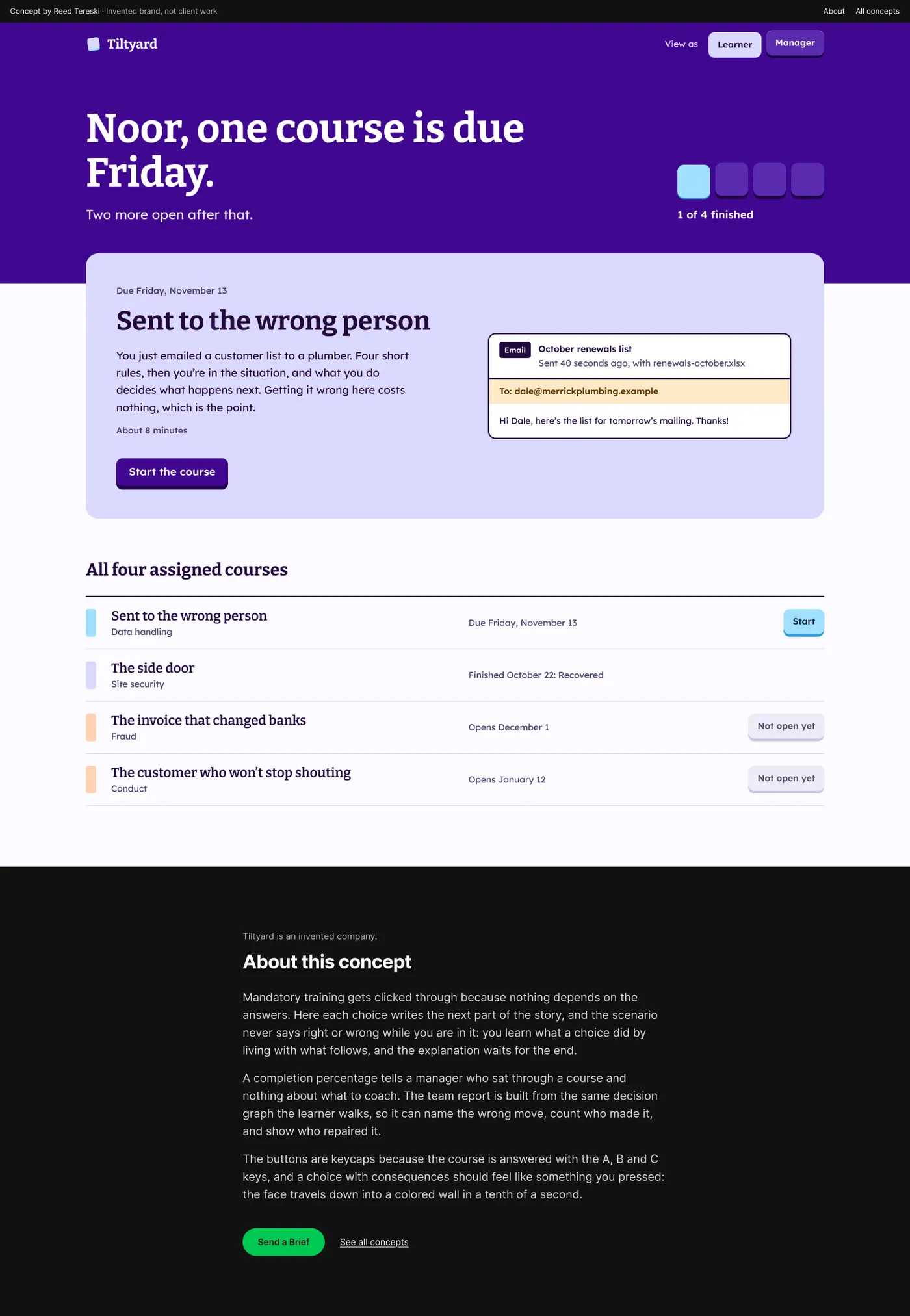
Noor, one course is due Friday.
Two more open after that.
1 of 4 finished
Due Friday, November 13
Sent to the wrong person
You just emailed a customer list to a plumber. Four short rules, then you’re in the situation, and what you do decides what happens next. Getting it wrong here costs nothing, which is the point.
About 8 minutes
To: dale@merrickplumbing.example
Hi Dale, here’s the list for tomorrow’s mailing. Thanks!
All four assigned courses
Sent to the wrong person
Data handling
Due Friday, November 13
The side door
Site security
Finished October 22: Recovered
The invoice that changed banks
Fraud
Opens December 1
The customer who won’t stop shouting
Conduct
Opens January 12
Hollis Varga, customer operations. Report on Sent to the wrong person.
4 of 9 tried to fix it before telling anyone.
9 of 11 finished. Not finished: Ines Okoye, Noor Haddad.
Showing 9 people
By skill
- Right call
- Recovered
- Slipped
- Did harm
| Skill | Reached | Right call | Recovered | Slipped | Did harm | Share of people |
|---|---|---|---|---|---|---|
| Reporting itAsk the team who the privacy lead is and how they would reach her after 5 p.m. | 9 | 3 | 3 | 1 | 2 | |
| Containing itGive people a short template for writing to a wrong recipient, so nobody composes one in a panic. | 8 | 4 | 2 | 1 | 1 | |
| Talking to the customerPractice one line out loud: I can’t answer that fully yet, and I’ll get someone who can today. | 9 | 6 | 1 | 1 | 1 |
Reporting it
- Reached
- 9
- Right call
- 3
- Recovered
- 3
- Slipped
- 1
- Did harm
- 2
Ask the team who the privacy lead is and how they would reach her after 5 p.m.
Containing it
- Reached
- 8
- Right call
- 4
- Recovered
- 2
- Slipped
- 1
- Did harm
- 1
Give people a short template for writing to a wrong recipient, so nobody composes one in a panic.
Talking to the customer
- Reached
- 9
- Right call
- 6
- Recovered
- 1
- Slipped
- 1
- Did harm
- 1
Practice one line out loud: I can’t answer that fully yet, and I’ll get someone who can today.
Wrong moves, most common first
- Tried to fix it before telling anyone4 people, 2 repaired it
- Deleted the sent message2 people, 1 repaired it
- Described the data in the follow-up2 people, 1 repaired it
- Told a customer it was fine before anyone knew1 person, 1 repaired it
- Waited for good news before reporting1 person
- Decided alone that it didn’t matter1 person
- Gave a partial account when asked1 person
- Denied it to a customer1 person
- Gave the privacy lead a guess as a fact1 person
- Kept a customer contact from the privacy lead1 person
- Took a verbal yes with nothing in writing1 person
- Closed it on a verbal promise1 person
- Left a second copy unconfirmed1 person
By person
| Person | Reporting it | Containing it | Talking to the customer | Where it went wrong | Outcome |
|---|---|---|---|---|---|
| Imani ClarkeService desk | Right call | Right call | Right call | Nothing went wrong | Handled |
| Tomasz BeckService desk | Recovered | Right call | Right call | Tried to fix it before telling anyoneRepaired it | Recovered |
| Ravi MenonService desk | Slipped | Recovered | Right call | Tried to fix it before telling anyone | Loose ends |
| Joss WhitlockService desk | Did harm | Not reached | Did harm | Tried to fix it before telling anyone | Left unrepaired |
| Wren CastellanoService desk | Did harm | Right call | Right call | Deleted the sent message | Left unrepaired |
| Delphine RoyField coordination | Right call | Recovered | Recovered | Described the data in the follow-upRepaired it | Recovered |
| Mei TanakaField coordination | Recovered | Right call | Slipped | Deleted the sent messageRepaired it | Loose ends |
| Callum ReyesField coordination | Right call | Slipped | Right call | Took a verbal yes with nothing in writing | Loose ends |
| Bea LindqvistField coordination | Recovered | Did harm | Right call | Tried to fix it before telling anyoneRepaired it | Left unrepaired |
- Handled
Imani Clarke
Service desk
Nothing went wrong
- Reporting itRight call
- Containing itRight call
- Talking to the customerRight call
- Recovered
Tomasz Beck
Service desk
Tried to fix it before telling anyoneRepaired it
- Reporting itRecovered
- Containing itRight call
- Talking to the customerRight call
- Loose ends
Ravi Menon
Service desk
Tried to fix it before telling anyone
- Reporting itSlipped
- Containing itRecovered
- Talking to the customerRight call
- Left unrepaired
Joss Whitlock
Service desk
Tried to fix it before telling anyone
- Reporting itDid harm
- Containing itNot reached
- Talking to the customerDid harm
- Left unrepaired
Wren Castellano
Service desk
Deleted the sent message
- Reporting itDid harm
- Containing itRight call
- Talking to the customerRight call
- Recovered
Delphine Roy
Field coordination
Described the data in the follow-upRepaired it
- Reporting itRight call
- Containing itRecovered
- Talking to the customerRecovered
- Loose ends
Mei Tanaka
Field coordination
Deleted the sent messageRepaired it
- Reporting itRecovered
- Containing itRight call
- Talking to the customerSlipped
- Loose ends
Callum Reyes
Field coordination
Took a verbal yes with nothing in writing
- Reporting itRight call
- Containing itSlipped
- Talking to the customerRight call
- Left unrepaired
Bea Lindqvist
Field coordination
Tried to fix it before telling anyoneRepaired it
- Reporting itRecovered
- Containing itDid harm
- Talking to the customerRight call
Tiltyard is an invented company.
About this concept
Mandatory training gets clicked through because nothing depends on the answers. Here each choice writes the next part of the story, and the scenario never says right or wrong while you are in it: you learn what a choice did by living with what follows, and the explanation waits for the end.
A completion percentage tells a manager who sat through a course and nothing about what to coach. The team report is built from the same decision graph the learner walks, so it can name the wrong move, count who made it, and show who repaired it.
The buttons are keycaps because the course is answered with the A, B and C keys, and a choice with consequences should feel like something you pressed: the face travels down into a colored wall in a tenth of a second.
Figma mockups

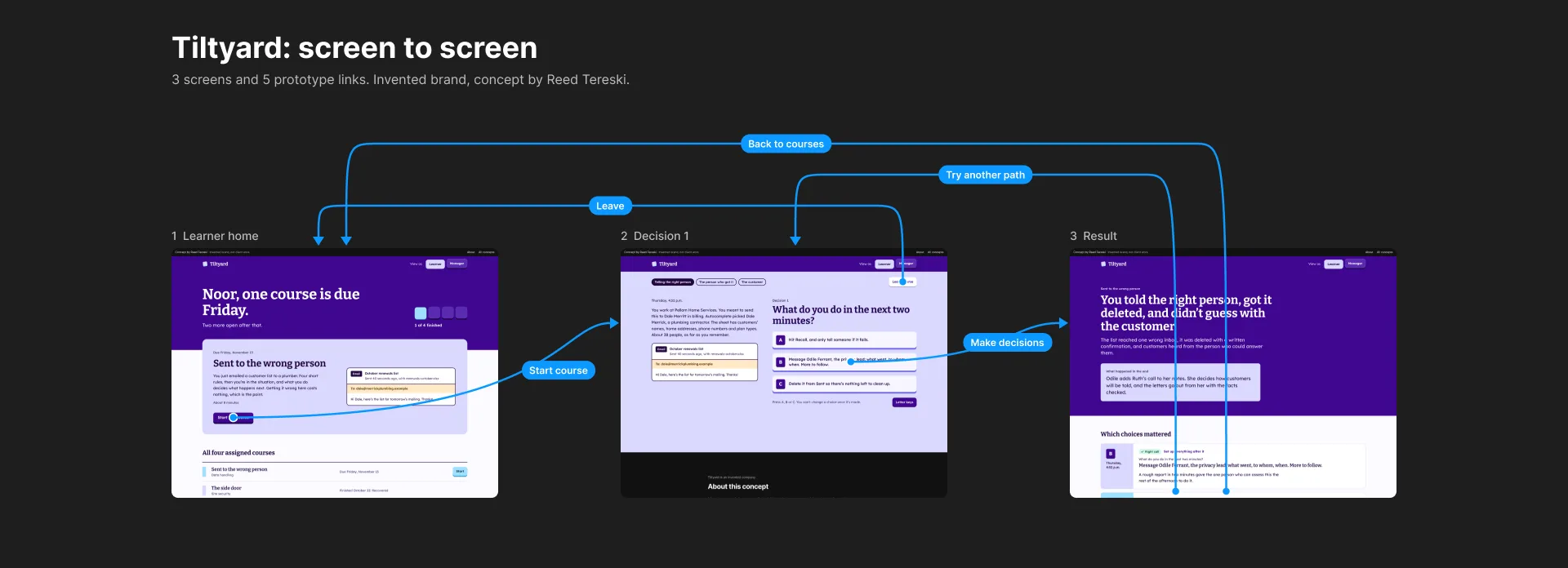
Prototype map
3 screens and 5 prototype links, drawn from the Figma file.